Geometry in strong gravity, quantum fields with changing boundaries, interface stability, and mathematical aspects of finance and economics are different languages for a common question: what structures are allowed, and what do they carry?
01
General Relativity and Black-Hole Spacetimes
In general relativity, matter and spacetime curvature determine one another through the Einstein equation:
Miyamoto's work in this area includes black-hole shadows, photon capture, high-energy processes near horizons, and cosmic censorship. Recent papers study parameter determination from black-hole shadow observations and the degeneracies that appear for finite-distance observers.
When fields are quantized on a curved or time-dependent background, even the vacuum becomes sensitive to geometry and boundary conditions. A central diagnostic is the renormalized stress tensor:
\[
\langle T_{\mu\nu}\rangle_{\mathrm{ren}}.
\]
The research includes dynamic Casimir effects, sudden changes of boundary conditions, and particle creation motivated by naked singularities, wormholes, and topology change.
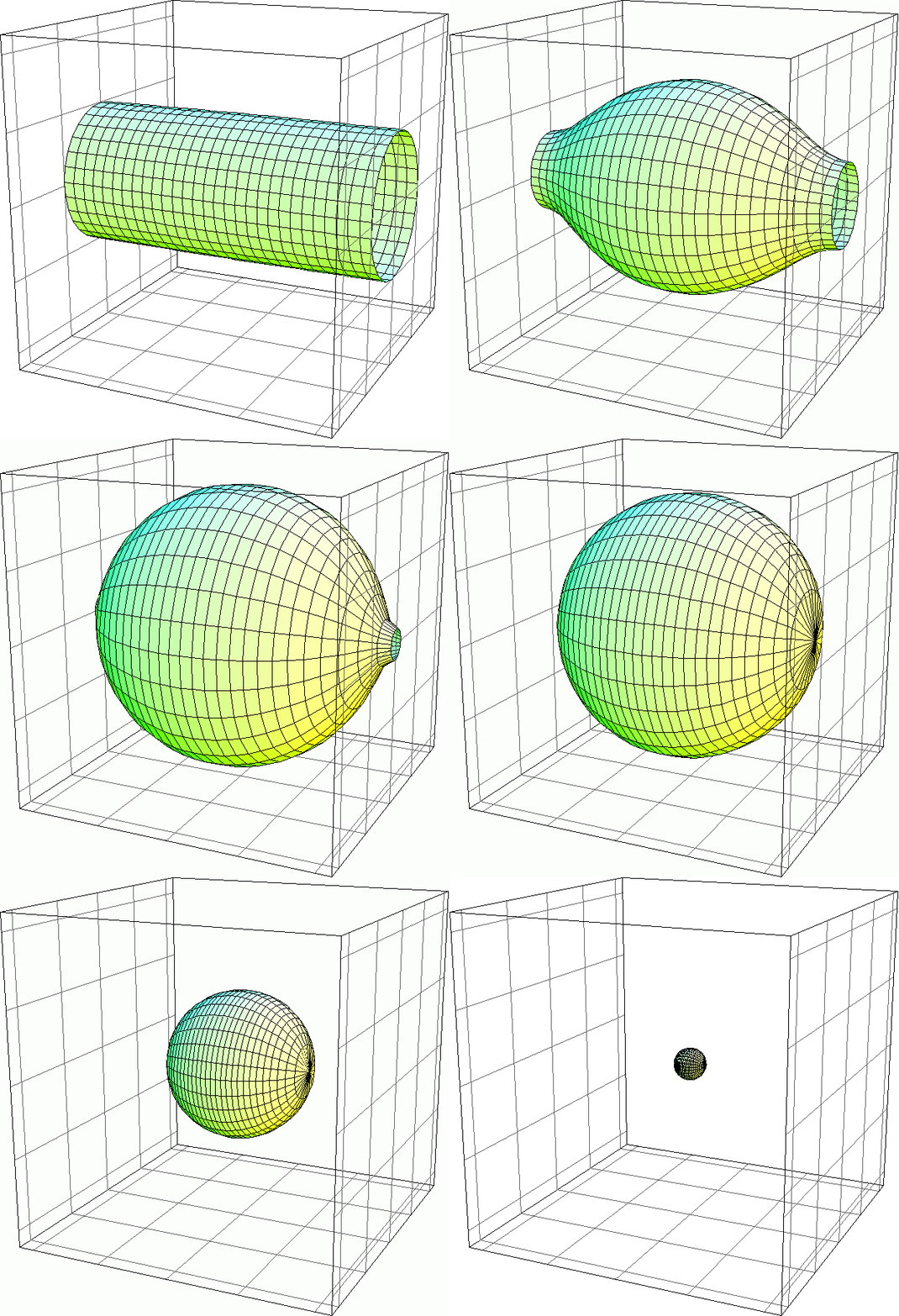
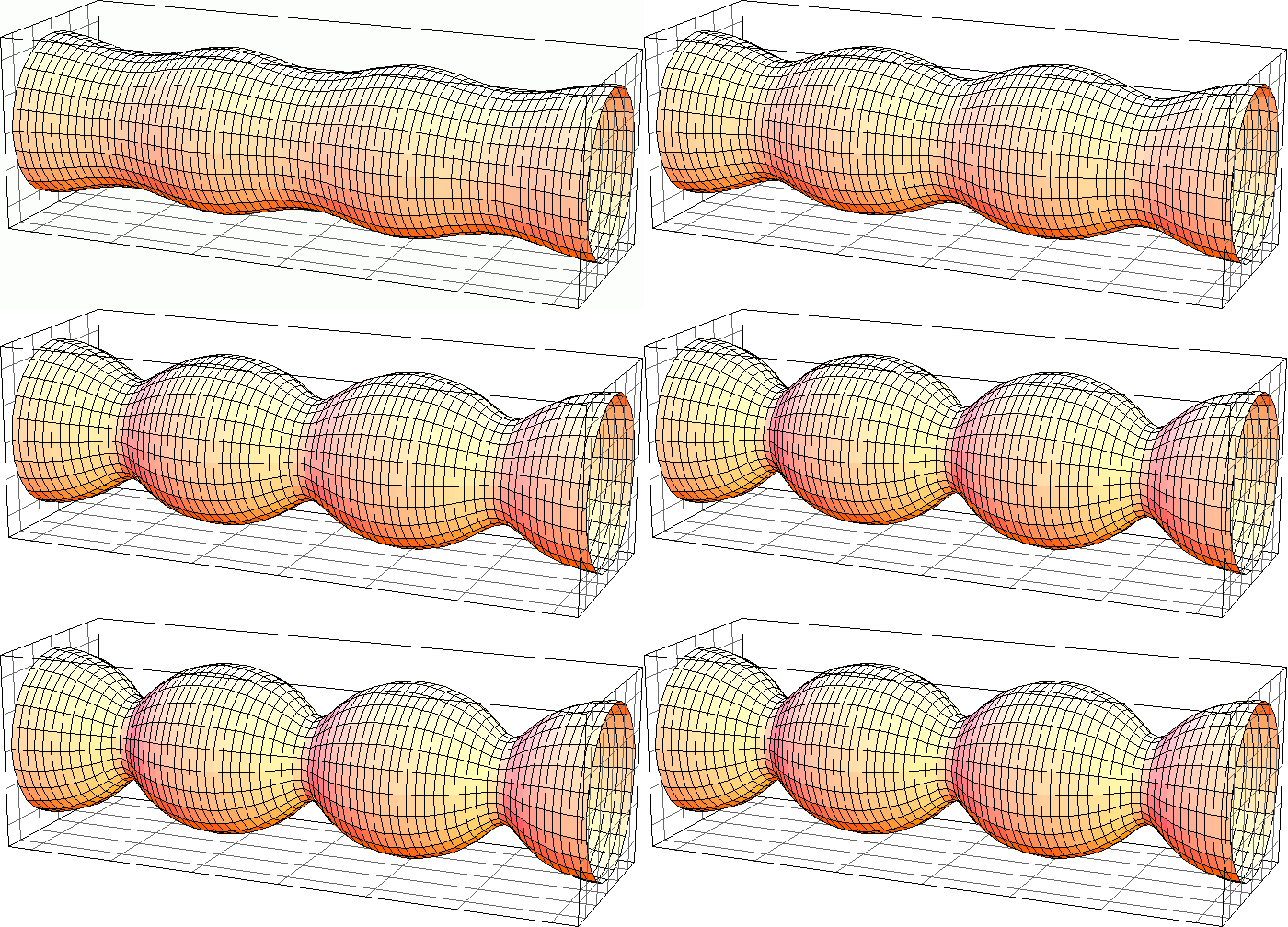
The Rayleigh-Plateau instability of liquid columns and the Gregory-Laflamme instability of black strings display a remarkable structural analogy. Miyamoto studies this relation through thin-flow equations, curvature-driven diffusion, and dimension-dependent phase diagrams.
4D bridge equilibriumSurface-diffusion evolution
\[
\partial_t X = -\Delta_s H,
\qquad
H=\mathrm{const.}
\]
The same mathematical vocabulary of stability and bifurcation helps compare fluids, membranes, black strings, and black branes.
Static shapes supported by surface tension are modeled by constant-mean-curvature surfaces, critical points of area under a volume constraint. Stability is encoded in the second variation:
\[
\delta^2 A \ge 0.
\]
This research examines high-dimensional CMC hypersurfaces, including those with free boundaries between parallel hyperplanes, combining analytic arguments with numerical computation.
constant mean curvaturestabilitydifferential geometry
In systems with many variables and implicit constraints, dimensional analysis can be formulated as a linear-algebraic problem in logarithmic variables:
\[
A \log x = b,
\qquad
C \log x = d.
\]
This viewpoint gives a systematic way to count independent dimensionless quantities and eliminate redundant ones without trial-and-error algebra. As noted in researchmap, recent interests also include mathematical aspects of finance and economics.